
Fire Safety assesment through risk analysis
Lo studio analizza il rischio incendio negli edifici, evidenziando i limiti dell’approccio Bow-Tie nella definizione di parametri e probabilità degli eventi. Propone un metodo più strutturato applicato a edifici in acciaio di media-alta altezza.
Indoor fires can lead to severe structural consequences, including collapse. Fire risk analysis in buildings is often scenario-based, using the Bow-Tie framework with Fault and Event Tree Analysis. However, this approach lacks universal criteria for assigning intensity parameters and event probabilities. This study proposes a method to define these parameters, focusing on fire risk in medium-high steel buildings. Key events include fire initiation, suppression, local collapse, and global collapse (Sway o No-Sway). Probabilities are derived from Italian fire brigades and ISTAT reports, while fire-specific structural effects are as-sessed through FEM analysis on a steel residential building.
The structural consequences of interior fires can be severe enough to lead to structure collapse; since these are rare events, fire leading to structural collapse is termed a low probability, high consequence (LP-HC) event. Fire risk analysis must therefore be approached with a pragmatic scenario-based approach using the so-called Bow-Tie framework, which combines fault tree analysis (FTA) and event tree analysis (ETA). FTA examines the fault chain leading to an incident, while ETA analyzes the possible consequences of the fire by assigning conditional probabilities. This methodology faces the difficulty of objectively defining intensity parameters and probabilities.
This study proposes objective criteria to assign these probabilities, considering the events: fire initiation, firefighter intervention, local collapse and global collapse (Sway and No-Sway). The objective is to develop a methodology to quantify fire risk and collapse probability based on the intended use of a building. Only the ETA part has been considered in this work.
IF CRASC ’25: ingegneria forense, crolli e affidabilità strutturale
IF CRASC ’25 ha posto al centro del confronto tecnico ingegneria forense, crolli, affidabilità e consolidamento strutturale, riunendo a Napoli esperti del settore per analizzare cause dei dissesti, responsabilità tecniche e soluzioni avanzate per la sicurezza del costruito, tra ricerca, pratica professionale e ambito giudiziario. All'interno interviste e video delle relazioni.
LEGGI L'APPROFONDIMENTO
Materials and methods
Fire Scenario
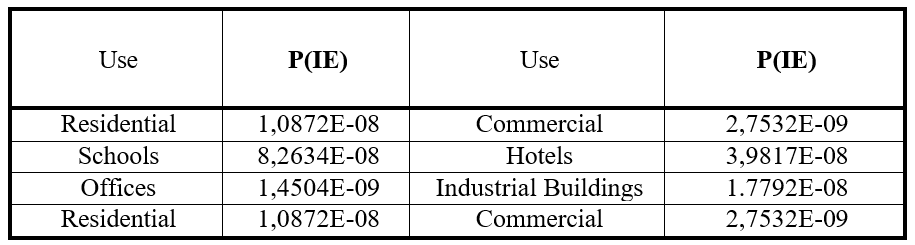
The event tree analysis begins with defining the fire scenario based on key parameters: fire load, ignition probability, ventilation, and fire location. The proposed methodology aims to define these key parameters for several intended uses: residential, hotels, offices, schools, commercial, and industrial buildings. The fire load (qf) is a parameter that depends on the quantity and quality of combustible material. To determine this parameter, it is possible to refer to the table in Appendix E of the standard EN 1991-1-2. The probability of the initiating event (P(IE)) is derived from the Italian Fire Brigades' annual statistics, calculated as the ratio of fires in a specific building type to the total yearly fires. This value is then normalized using ISTAT data on the total number of such buildings. Table1 lists the final prob- ability for each building use is obtained by averaging the normalized yearly values, with a return period of one year. Since industrial buildings are not included in the Italian fire service's statistical yearbook, NFPA reports from the US were used as a reference.
Firefighters Suppression Event
In order to determine the probabilities to be associated with the branch of the ETA related to fire suppression by firefighters, it is necessary to introduce the intervention time (ti); the time to reach the maximum energy development (tα) and the time of reaching the maximum temperature (tmax), which coincides with the beginning of the phase of decay. ti includes the detection and alarm time (te), preparation and dispatch time for rescue teams (tp), travel time from the fire station to the fire location (tg), and extinguishment time (th).
To determine the detection and alarm time, reference is made to life risk profiles defined by standards (D.M. 03/08/2015), where the risk profile is an indicative measure of fire risk severity, with specific reference to life safety (Rlife). This indicator, represented by a letter and number, reflects the characteristics of the occupants and fire growth. The detection time can be determined using the table in ISO/TR 16738, based on this profile risk. The preparation and dispatch time for rescue teams is set at three minutes, as per National Fire Department guidelines.
Arrival and extinguishment times are derived from statistical yearbooks, with minimum and maximum values calculated using average extremes from yearly data, ensur- ing realistic estimation of response and firefighting times. Table 2 shows the average values. To determine the time tα to reach the maximum energy development and the time of reaching the maximum temperature the RHR (Rate of Heat Release) parameter is used. The RHR parameter describes fire development, representing the thermal power released into the compartment over time during the fire's evolution. To estimate time tα is used the maximum RHR value, using the equation (1).

Where: m combustion participation factor, equal 0.8; H lower heating value of wood equal to 17500 kJ/kg; Av total area of vertical openings in all compartments’ wall.
...Continua a leggere la memoria nel PDF in allegato (in lingua inglese).


Antincendio
Tutto sull’antincendio: normative, impianti, tecnologie, progettazione e gestione del rischio. Una guida tecnica completa con articoli, approfondimenti e soluzioni a cura degli esperti di INGENIO.

Costruzioni Metalliche
Le costruzioni metalliche rappresentano una scelta strategica per strutture leggere, sicure, resistenti e sostenibili. Scopri su INGENIO tecniche, norme e soluzioni per progettare con l’acciaio.

Ingegneria Strutturale
L’ingegneria strutturale garantisce sicurezza e durabilità alle costruzioni. Scopri su INGENIO materiali, norme, tecnologie e soluzioni per progettare, rinforzare e monitorare strutture nuove ed esistenti.

Sicurezza
Gli approfondimenti e le news riguardanti il tema della sicurezza intesa sia come strutturale, antincendio, sul lavoro, ambientale, informatica, ecc.
Condividi su: Facebook LinkedIn Twitter WhatsApp